
Around 70% of people believe vision boards increase the chances of success. Most vision boards end up in a drawer within a few months. If you want yours to actually work, you need a vision board with your photos. You need a plan backed by real research.
This guide gives you the exact steps, the science behind why they work, and the stats that prove it. By the end, you will know how to build a vision board that keeps you focused and moving forward, not one that just sits on a wall.
- Why Most Vision Boards Fail
- The Science: Why a Vision Board Works
- Vision Board Statistics You Should Know
- How to Make a Vision Board That Works: 9 Steps
- Step 1: Write Your Goals Before You Touch a Single Image
- Step 2: Make Every Goal Specific
- Step 3: Choose Personal Images Over Generic Stock Photos
- Step 4: Put Your Own Face on Key Goal Images for Extra Motivation
- Step 5: Add Words, Numbers, and Short Phrases
- Step 6: Arrange Your Board by Life Category
- Step 7: Place Your Board Where You’ll See It Every Day
- Step 8: Pair Every Goal With One Small Action
- Step 9: Review and Update Your Board Regularly
- Digital vs. Physical: Which Vision Board Works Better?
- Vision Board Mistakes That Kill Your Results
- How to Keep Your Vision Board Working the Whole Year
- FAQs: How to Make a Vision Board That Works
Why Most Vision Boards Fail
A vision board fails for one main reason. It stays a collage of pictures and never turns into a plan. You glue on some photos, feel excited for a week, then forget the board exists.
The fix is not more pictures or a bigger board. The fix is a method that ties each image to a clear goal and a real action. That is what turns a craft project into a tool that works.
Tip: Use your face in every image of your vision board.
The Science: Why a Vision Board Works
A vision board is not just a feel-good exercise. Real brain research explains why it can help you reach your goals.
Your Brain Has a Built-In Filter

Your brain uses a network called the Reticular Activating System, or RAS, to filter what you notice each day. This system decides which sights, sounds, and details reach your conscious awareness, since your brain cannot process everything at once. The RAS filters out information that doesn’t matter to you and lets in details tied to your current goals and focus.
This is why buying a certain car makes you suddenly notice that same car everywhere. Your vision board works the same way. Looking at your goals daily trains your RAS to notice chances, people, and resources tied to them.
Seeing Your Future Self Changes Your Choices

Marketing researcher Hal Hershfield studied how people connect with their future selves. In his study, people who saw age-progressed images of their own future face chose to put more money toward retirement than people who did not see those images. He found that people often feel emotionally disconnected from who they will become, and that gap leads to weaker choices in the present.
This finding matters for your vision board. The more real and personal your images feel, the more your brain treats your goals as truly yours.
Vision Board Statistics You Should Know
These numbers show why the right approach matters more than the board itself.
| Statistic | What It Shows |
| 70% vs. 35% | People who wrote goals and sent weekly progress updates to a friend succeeded far more than people who kept goals to themselves. |
| 267 participants, 149 completed | Dr. Gail Matthews recruited 267 people across businesses and organizations worldwide for her landmark goal-achievement study. |
| Age 23 to 72 | Matthews’ study included participants across a wide age range and professional background. |
| A common myth to skip | The often-cited “3% of Harvard grads with written goals earned 10 times more” story has been confirmed as an urban myth with no real study behind it. |
That last stat matters. A lot of vision board advice repeats a myth as fact. This guide sticks to research that has actually been verified, so you can trust what you build your board on.
How to Make a Vision Board That Works: 9 Steps
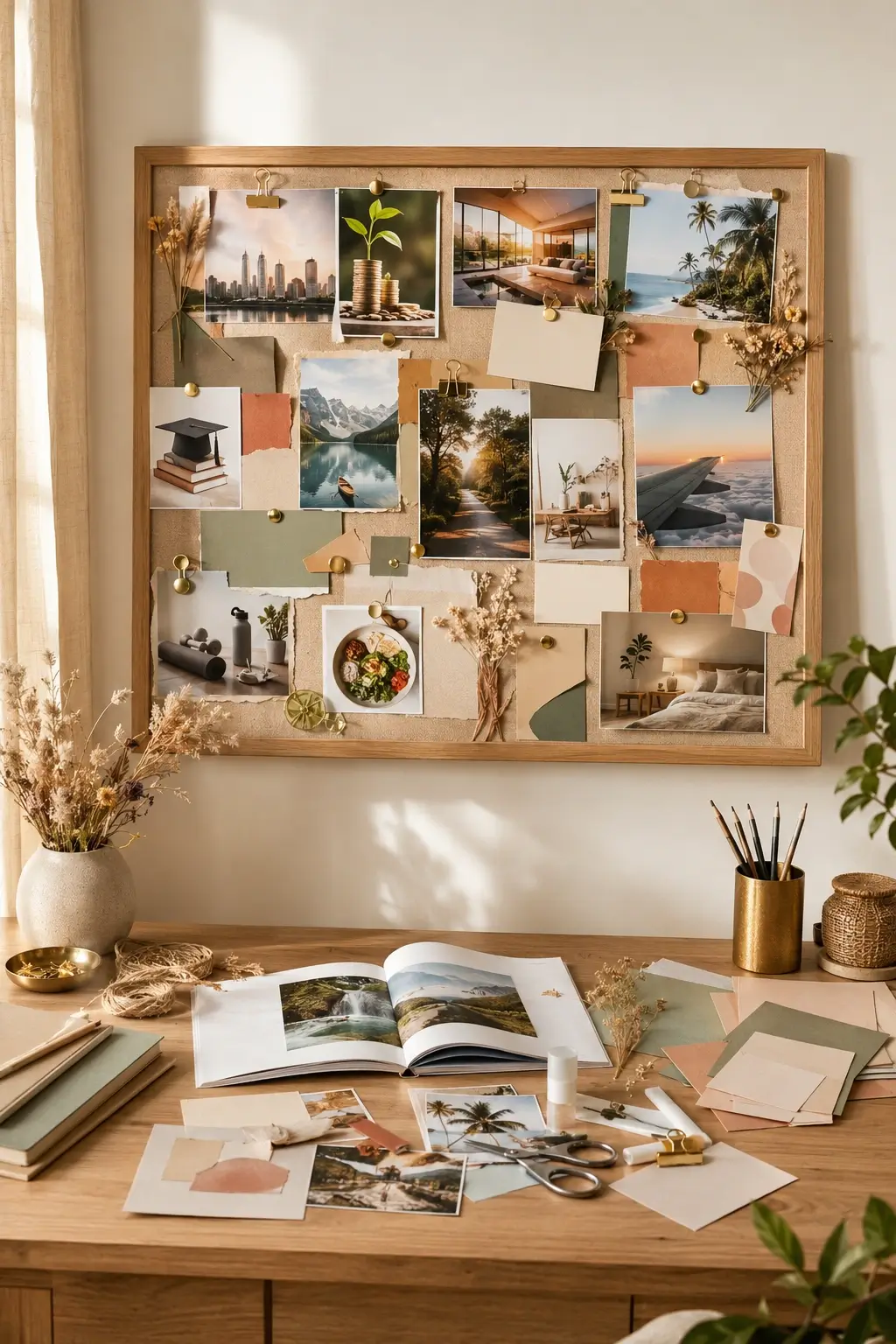
Follow these steps in order. Each one builds on the last, so do not skip ahead.
Step 1: Write Your Goals Before You Touch a Single Image
Start with words, not pictures. List five to eight goals that matter most to you right now. This keeps your board grounded in real intentions, not random inspiration.
Step 2: Make Every Goal Specific
Unclear goals give your brain nothing to act on. “Get healthy” is too broad. “Walk 20 minutes a day, four days a week” gives your RAS a clear target to filter for.
Step 3: Choose Personal Images Over Generic Stock Photos
Your brain responds more strongly to images that feel close to your real life. A photo tied to your actual goal works better than a random picture that only loosely fits.
Step 4: Put Your Own Face on Key Goal Images for Extra Motivation
This step makes a real difference. For your biggest goals, swap your own face onto the picture instead of using a stranger’s photo. Want to become a doctor? Use a photo of a doctor in a white coat, but make the face yours.
This works because seeing yourself already living a goal makes that goal feel closer and more achievable, the same effect researchers found when people viewed images of their own future selves. You can do this with a free app like Canva or a face swap tool, or simply glue a small printed photo of your face over a magazine cutout.
Save this trick for two or three of your top goals. You do not need to swap every photo, just the ones tied to your biggest priorities.
Step 5: Add Words, Numbers, and Short Phrases
Pair each image with a short phrase or a specific number, like a savings goal or a target date. Words add clarity that a picture alone cannot always give.
Step 6: Arrange Your Board by Life Category
Group your images by area, such as career, health, relationships, and home. This keeps your board organized and easy to scan at a glance.
Step 7: Place Your Board Where You’ll See It Every Day
A board tucked in a drawer cannot help you. Hang it on a wall you pass daily, or set a digital version as your phone’s lock screen.
Step 8: Pair Every Goal With One Small Action
Writing goals down and sharing progress with another person leads to far higher success rates than keeping goals private, based on Matthews’ research. Attach one small, repeatable action to each goal, and check in on it weekly, ideally with a friend.
Step 9: Review and Update Your Board Regularly
Check your board every few weeks. Update it as goals shift or as you make progress. A board that grows with you stays useful far longer than one you build once and forget.
Digital vs. Physical: Which Vision Board Works Better?
Both formats can work well. The right choice depends on your habits, not which one looks nicer.
| Factor | Digital Vision Board | Physical Vision Board |
| Setup time | Fast, with apps like Canva or Pinterest | Slower, needs cutting and gluing |
| Visibility | Easy to set as a phone lock screen | Depends on wall or room placement |
| Editing | Simple to update anytime | Harder to change once glued down |
| Personal touch | Easy to add your own face or photos | Great for texture, like fabric or handwriting |
| Best for | People who check their phones often | People who enjoy hands-on projects |
Pick the format you will actually look at every day. A simple board you check daily beats a beautiful board you forget about.
Vision Board Mistakes That Kill Your Results
Watch for these common mistakes if you want your board to actually work.
Picking images before setting goals. Random pretty pictures without a clear goal behind them will not guide your actions.
Staying too vague. Broad goals like “be successful” give your brain nothing specific to filter for.
Skipping the action step. A board with no real plan behind it stays just a hope, not a result.
Hiding the board. A board you never see cannot train your attention or keep you motivated.
Never updating it. Goals shift as you grow. A board frozen in time loses its power over time.
How to Keep Your Vision Board Working the Whole Year
Building the board is half the work. These habits keep it working long after you finish it.
- Check in daily. Watch daily for around 5 minutes and feel it keeps your goals fresh in your mind.
- Track progress with a friend. Sharing updates with someone else roughly doubles your odds of following through, based on Matthews’ research.
- Celebrate small wins. Mark progress on your board as you hit milestones, not just final goals.
- Refresh your images. Use different images of your own face, as your goals evolve.
FAQs: How to Make a Vision Board That Works
Do vision boards actually work?
Yes, when you pair them with specific goals and real action. Your brain’s attention filter, the RAS, works better when your goals are clear and visible, which is exactly what a well-built vision board provides.
Does using my own face on the board really help?
Yes. Research on future self-connection shows that seeing yourself in a goal image makes that goal feel more real and personal, which can boost follow-through.
How many goals can I put on my vision board?
Try to keep it up to five to eight goals across a few life areas. This keeps your board focused instead of scattered.
Is it possible to make a digital or physical vision board?
Choose whichever one you will check daily. Digital works well for phone users. Physical works well if you enjoy hands-on projects.
How often should I can update my vision board?
Review it every few weeks, and update it fully every three to six months, or whenever your goals shift.
Is the “3% of Harvard grads” vision board story true?
No. That story has been confirmed as an urban myth with no real study behind it. Rely on verified research, like Gail Matthews’ goal-writing study, instead.
Conclusion
I hope you enjoy this guide. After reading this, you understand the science behind how vision boards work. Simply use your face in photos. That increases your motivation. When you see your photo in any field. It will become more professional. Help you to feel that profession. Visit luxehomedecors.com for more home decor tips.